
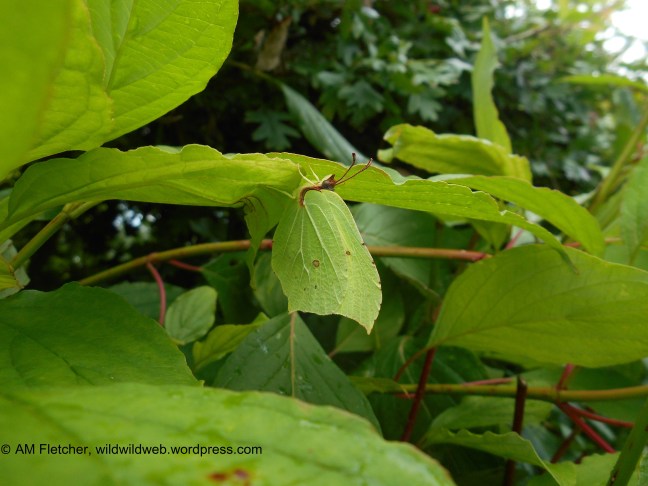
The Brimstone butterfly flashes its distinctive yellow upperwings in flight, but at rest, it folds up, drawing its leafy green hindwings over its forewings and vanishing into the foliage.
This butterfly is one of my favourites because of its dainty attention to camouflage. Look at its woody antennae and its reddish specks resembling wear and tear on a leaf.
I took these photos in Hampshire, throughout August. Brimstone butterflies can live for up to a year long: these adults will continue to build fat reserves throughout autumn, and hibernate over winter. They can emerge as early as February if the weather is warm enough.


Brimstone caterpillars eat purging buckthorn and alder buckthorn. Species like Brimstone which produce only one generation per year are called univoltine.
The brimstone’s yellow upperside is often credited with inspiring the name ‘butter-fly’, or ‘buttorfleoge’ in Old English. English is the only language that still uses this combination of ideas, ‘butter’ and ‘fly’, to describe the insect today. In Welsh, butterflies are sometimes called ‘iâr fach yr haf’ which means ‘little summer hen’. Brimstone butterflies can be found across the UK: in Northern Ireland, Wales, and anywhere in England south of the Lake District.
Sources
All photographs are my own.
Brimstone (Gonepteryx rhamni). The Woodland Trust. Web. 2 Sep 2017. https://www.woodlandtrust.org.uk/visiting-woods/trees-woods-and-wildlife/animals/insects-and-invertebrates/butterflies/brimstone/
RSBP Wildlife of Britain: The Definitive Visual Guide (London: Dorling Kindersley Ltd, 2011) p 191
 wildwildweb.org
You must be logged in to post a comment.