
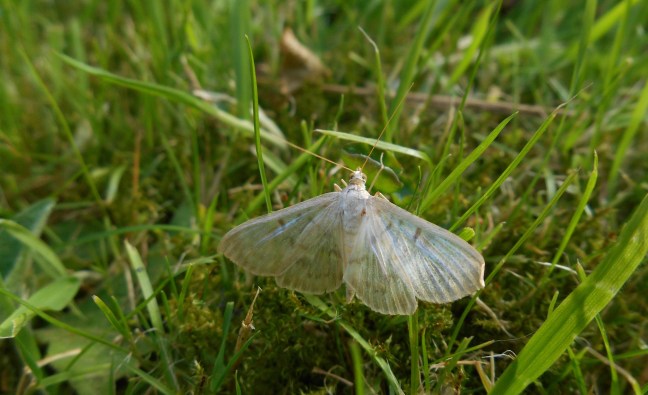
I found this Mother of Pearl moth on a sunny afternoon in Hampshire, resting near to a wildflower meadow. With a wingspan of just 26mm, it was only noticeable because it has a pearly sheen when it catches the light at certain angles. Otherwise, this moth appeared almost translucent.
![DSCN6583[1]](https://wildwildweb.org/wp-content/uploads/2017/09/dscn65831.jpg?w=648)
These moths usually fly at dusk. Moth classification systems have not been very successful – I’ll soon write a post explaining why – but when moths are classed as either micro or macro, the Mother of Pearl is one of the larger micro species.
To escape from predators, a Mother of Pearl caterpillar can roll its soft, jointless body into a ball and propel itself along at high speed. This behaviour is called ballistic rolling.
Caterpillars like this inspired scientists at Tuft University Departments of Biology and Mechanical Engineering to create GoQBot, a robot that moves by ballistic rolling. Find out more at http://iopscience.iop.org/article/10.1088/1748-3182/6/2/026007/meta, and see it in action here: https://www.youtube.com/watch?v=wZe9qWi-LUo.
Sources
All photographs are my own.
Kimber, Ian. Mother of Pearl (Pleuroptya ruralis). UK Moths, 2017. Web. 3 September 2017. http://www.ukmoths.org.uk/species/pleuroptya-ruralis/adult-2/
RSBP Wildlife of Britain: The Definitive Visual Guide (London: Dorling Kindersley Ltd, 2011)
Wall, Mike. Mother of Pearl Pleuroptya ruralis. Hants Moths. Web. 3 September 2017. http://www.hantsmoths.org.uk/species/1405.php
 wildwildweb.org
You must be logged in to post a comment.