
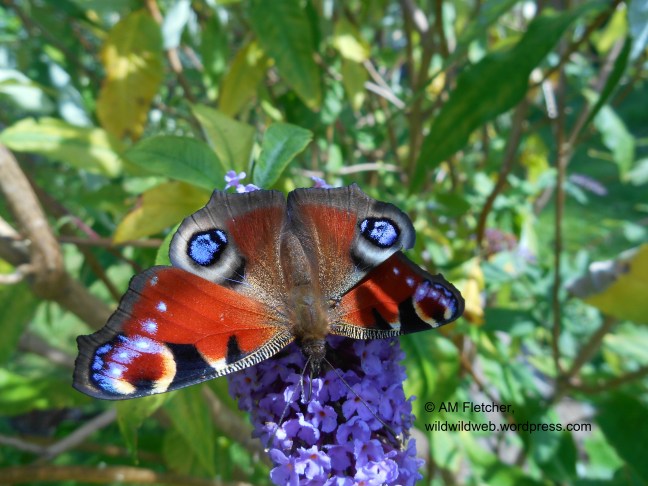
Peacock butterflies are a hibernating species, attracted to wooded areas as well as to the nettles and hops where they lay their eggs. The adults feed on nectar and mate from March to May, and then their offspring emerge from chrysalises from July to September. They are commonly found in parks and gardens across Europe.
Their eye markings divide ecological opinion. Some scientists argue that the marks deter predators by mimicking another predator. On the upside-down butterfly above, you can see how the eye markings on the hindwings, coupled with the tapered brown body, look similar to the eyes and beak of a bird. However, others suggest that these marks are simply bold and therefore alarming visual deterrents, like the markings found upon many caterpillars.


The males are territorial. The reproductively successful male finds an area that is rich in nectar, or in plants on which the females lay their eggs. He defends this desirable area, fighting off male competition, and courts and mates with a female who passes through. Aglais io is an unusual species in that an individual butterfly only mates once.
When disturbed, a hibernating Peacock butterfly will often rub its wings together to make a hissing noise. This second defensive strategy is particularly useful in the dark, where its eye markings cannot be seen. Peacock caterpillars are also well adapted to defence, spinning a web and sheltering within it together.
Sources
Bradbury, Kate. The Wildlife Gardener: Creating a Haven for Birds, Bees and Butterflies (London: Kyle Books, 2013) p 113
Martin Stevens, Chloe J. Hardman, Claire L. Stubbins. ‘Conspicuousness, not eye mimicry, makes “eyespots” effective antipredator signals’, Behavioral Ecology, Volume 19, Issue 3, 1 May 2008, Pages 525–531. https://doi.org/10.1093/beheco/arm162
 wildwildweb.org
One thought on “European Peacock”
Comments are closed.