

Back in May this year, Oxford’s Mesopotamia Walk was full of Orange Tip butterflies. This spring butterfly seeks out damp areas, and the path running through the Cherwell River, surrounded by meadows, provides an ideal habitat.
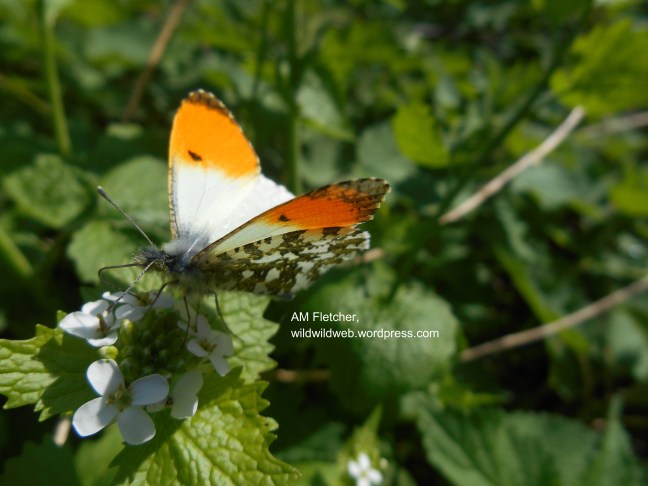
Orange Tips are among the first butterflies to emerge each year. They spend the winter as chrysalises. Cuckooflowers, named for their blossom coinciding with another spring arrival, are a crucial foodplant for their larvae.
Their eggs gradually change from white to orange, and you will only find one egg per foodplant. The females lay them individually because the larvae tend to eat each other.
Female Orange Tips lack any orange marks – their plainer colours allow them to lay eggs undetected by predators. However, you can tell them apart from Small Whites by the mottled golden patterns on their underwings (see below), found also on the males.
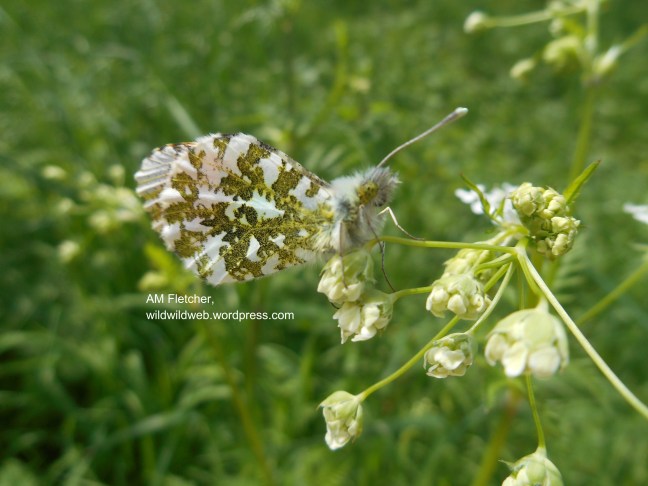
Orange Tips have flourished over the past thirty years, becoming more widely distributed and more common across Britain and Ireland. In particular, sightings have become more widespread in Scotland. Very few British butterflies enjoy such a promising status.


Sources
All photographs by AM Fletcher
Butterfly Conservation, ‘Orange-tip’ (2000-2016) <https://butterfly-conservation.org/butterflies/orange-tip>
Eeles, Peter, ‘Orange-tip’, UK Butterflies (2002-2018)<https://www.ukbutterflies.co.uk/species.php?species=cardamines>
RSPB, ‘Orange-tip Butterfly’ <https://www.rspb.org.uk/birds-and-wildlife/wildlife-guides/other-garden-wildlife/insects-and-other-invertebrates/butterflies/orange-tip-butterfly/>
 wildwildweb.org
You must be logged in to post a comment.