
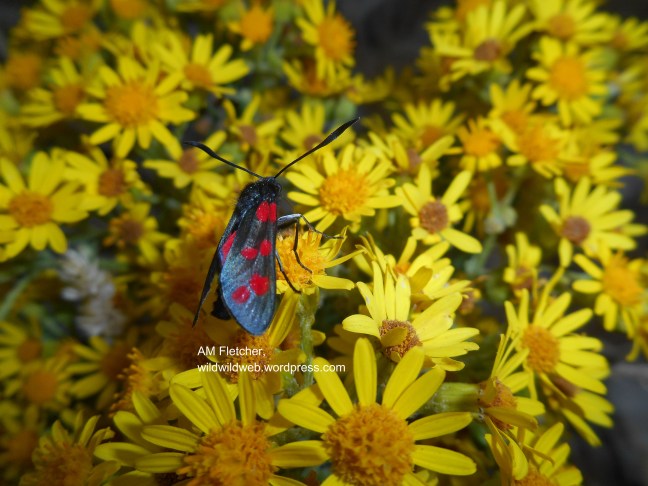
This strikingly bright moth flies during the daytime. I found this species at all stages – ovum, larvae, pupae and imago – at midday on a beach in Dorset.


Their cocoons (or ‘pupae’) dangled from long grasses among the sand dunes, and the adult moths (‘imago’) swarmed around thistles. They flew with a whirring motion, so that they more closely resembled a beetle than a butterfly.
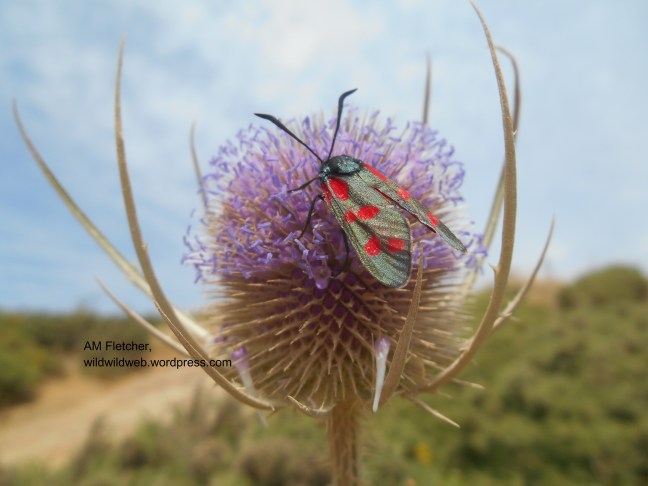
Most moths fly at night to avoid competition and predation, but Six-spot Burnets love warm, sunny days. Their caterpillars feed mostly on Bird’s Foot Trefoil. This larval foodplant helps the moths to produce hydrogen cyanide, which tastes disgusting and in large quantities could kill a predator.
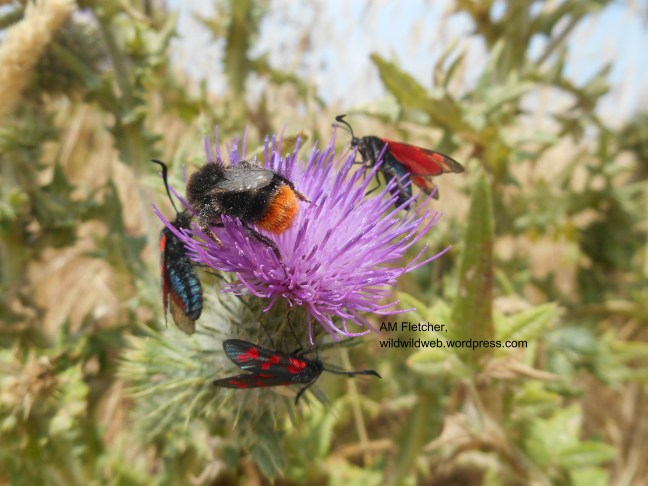
The Six-spot is the one of seven Burnet moth species native to Britain. All of them share these distinctive crimson markings. The beach I visited is close to New Forest, after which the similar New Forest Burnet Moth is named: this rarer, endangered species (not pictured) is slightly smaller, with fewer spots.

Sources
All photographs: AM Fletcher
BBC Nature, ‘Burnet Moth’ (2018) <http://www.bbc.co.uk/nature/life/Zygaenidae>
Pavid, Katie, ‘Toxic Talents of Britain’s Cyanide Moths’, Natural History Museum (2016) <http://www.nhm.ac.uk/discover/toxic-talents-cyanide-moths.html>
‘Six-spot Burnet’, Butterfly Conservation (2000-2016) <https://butterfly-conservation.org/moths/new-forest-burnet>
‘Six-Spot Burnet: Zygaena filipendulae’, UK Moths <https://ukmoths.org.uk/species/zygaena-filipendulae/>
 wildwildweb.org
You must be logged in to post a comment.