
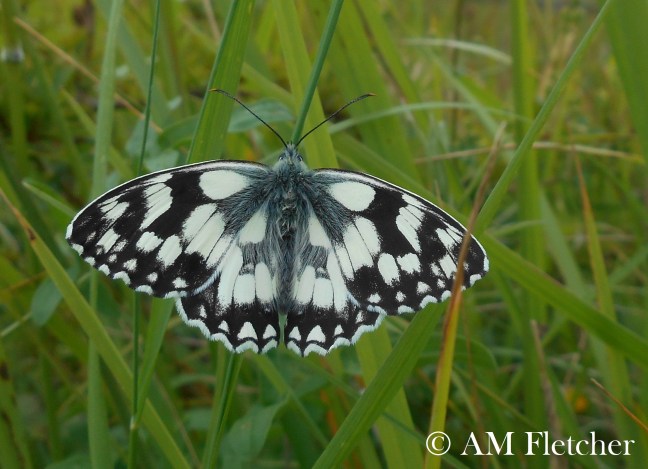
These unmistakable monochrome butterflies like to bask in the morning sunshine. They live on chalk and limestone downland, particularly in southern England.
They lay eggs across grassy areas, and the hatched caterpillars hibernate underground, emerging in warmer months to feed on specific grass species.
The adult butterflies prefer nectar from purple flowers like Common Knapweed and Wild Marjoram. The undersides of their wings appear more faded, with a yellow tint in females.


Marbled Whites live in colonies. Colonies occur when one butterfly species is split into geographically isolated, local groups.
Most British butterfly species have declined since the 1970s. However, Marbled White colonies have become far more common and widespread, most likely due to a warmer climate.
These photos show a colony on Pewley Down, Guildford.

Sources
Eeles, Peter, ‘Marbled White’ (UK: UK Butterflies, 2020) https://www.ukbutterflies.co.uk/species.php?species=galathea
‘Instructions for Recorders’ (UK: Butterfly Conservation, 2020) https://butterfly-conservation.org/our-work/recording-and-monitoring/butterflies-for-the-new-millennium/instructions-for-recorders
‘Marbled White’ (UK: Butterfly Conservation, 2020) https://butterfly-conservation.org/butterflies/marbled-white
‘Marbled White Butterflies’ (UK: UK Safari, 2014) https://www.uksafari.com/marbledwhite.htm
Scott, James A, The Butterflies of North America: A Natural History and Field Guide (Stanford: Stanford University Press, 1992) p 544
‘The State of Britain’s Butterflies’ (UK: Butterfly Conservation, 2020) https://butterfly-conservation.org/butterflies/the-state-of-britains-butterflies
 wildwildweb.org
You must be logged in to post a comment.